
Prominent Figures of the Kerala Church-11
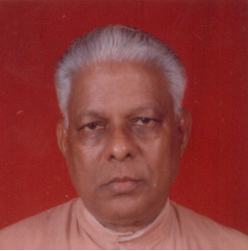
George Thekkayyam
After completing his high school education, George Thekkayyam aspired to join a college for higher studies. However, circumstances did not permit this. He then pursued technical education and went abroad for work. Upon returning, he still did not get the opportunity for further studies. To support himself, he had to engage in various jobs. Despite this, he continued to hold on to the idea of higher education. After completing his high school education, he began university studies through correspondence in 1986 at the age of 68. He earned a Bachelor’s degree at 71 and a Master’s degree at 75. He then pursued another Master’s degree in Sociology at the University of Mysore. Unfortunately, he had to discontinue his studies after a bus accident. The degrees he achieved were not for financial gain but solely for the purpose of acquiring knowledge. His life was dedicated to this goal, which he achieved through his own efforts.
During World War II, George Thakkayyam registered to join the Indian National Army formed by Subhas Chandra Bose, while living in Singapore. However, intervention by the Japanese government denied him this opportunity. George Thakkayyam was born on January 25, 1918, in the model village of Kadavoor Thodi. His father, Leon Thakkayyam, and mother, Elizabeth, were from the Thakkayyam family, located two kilometers away from the Thrikkadavoor Mahakshetram.
In the southern part of the English middle school, there was an evening market. Nearby, in a moderately extensive grassy field, it was common for local educated people and young listeners to gather in the evening. George Thakkayyam’s father was known for reading and discussing poetry from the poets of the Traya (a group of three poets) and explaining their meanings. Despite lacking wealth or fame, he was known as a scholar and a good speaker. He also performed presentation speeches in local plays. For business purposes, George Thakkayyam’s father frequently traveled to Alappuzha.
George completed his primary and middle school education. During this time, his father died of poisoning, and he, along with his mother and siblings, moved to the maternal home. George had a keen interest in attending musical dramas and dance dramas continuously performed in the local area. Although he wanted to join a college for higher education after high school, it did not materialize. He became involved in household chores, overseeing tasks like making ropes for household use, bundling for Alappuzha, dealing with mouth infections, and collecting coconuts from local estates. After a year, he joined the Civil Engineering School in Paravur and passed the higher grade examination within two years. George worked for a few months as a librarian and teacher at St. Aloysius School, where he completed his high school education. His uncles, friends, and relatives were working in Singapore, and he went there for employment. He worked in various companies and enrolled in a civil engineering course at the University of Melbourne in Australia. After completing his studies there, he returned to Singapore.
George Thekkayyam found foreign work both challenging and enjoyable. In his autobiography, “Gathakal Smaranakal,” he wrote about his experiences in foreign lands. He had the chance to visit remote and mountainous areas, see wild animals and forest dwellers, and live with them, which he described as a rare experience in his life.
Seeking a better life, he lived and experienced new things in Singapore, Malaya, Indonesia, Sarawak, Borneo, and Brunei. During World War II, after Subhas Chandra Bose arrived safely on the Malayan coast by German submarine and then went to Singapore, George Thakkayyam joined the local people in welcoming him. Enthralled by the call to join the Indian National Army, Thakkayyam registered for it. However, the Japanese Army’s contracting company, Obayashigumi, which was recruiting European contractors, also invited Thakkayyam to work. A letter from the Indian National Army’s camp urged him to join immediately, but the Japanese authorities advised him to stay away. Many of Thakkayyam’s friends had already started training in the Indian National Army camp. Thakkayyam, dreaming of training and joining the fight on the Burma front as a weapon bearer, returned disappointed from the I.N.A. office.
After a month in Sarawak, George Thekkayyam was elected as the President of the Sarawak Indian Association. Subsequently, he was selected as the Indian representative in the Sarawak Municipal Advisory Council. When the Indian High Commissioner arrived in Sarawak, Thakkayyam was able to provide a grand reception and present the issues of the Indian community as the Association President. Afterward, he joined government service for four years.
After the contract with the Sarawak Government ended, he returned home after 20 years of significant foreign service. He engaged in business and established a coconut oil mill. Later, he joined the Caltex Company.
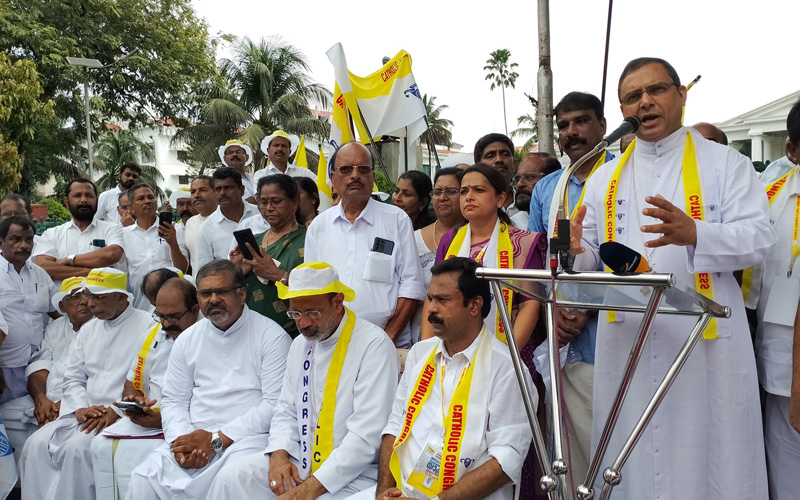
In 1972, the Kerala Catholic Association was formed. At a meeting held at St. Albert’s College in the presence of Archbishop Kelethara, K.J. Burly was elected President of the Latin Catholic Association. Thekkayyam was one of the five members chosen from the Kollam diocese for the K.L.C.A. managing committee. K.J. Burly served as President for 12 years, after which George Thakkayyam was elected President. He continued in this role for nine years. During Thakkayyam’s presidency, the Mandal Commission Report was submitted, and Prime Minister Indira Gandhi declared that prompt action would be taken on it. After Indira Gandhi’s death, Rajiv Gandhi, who came to power, did not take any action on this matter. In protest, the backward sections of the society started a nationwide agitation. Concurrently, under the leadership of Sri Vishwanathan, President of the S.N.D.P. Yogam, a Backward Community Front was formed, which later transformed into a Reserved Community Front. The K.L.C.A. was an active participant in this front. George Thakkayyam was elected Vice President of this front. A Reserved Community march was conducted from Ernakulam to Kochi, Alappuzha, Kollam, Thiruvananthapuram, Vellinjom, and Thuttur. The 13-day march culminated in a demonstration in front of the Secretariat in Thiruvananthapuram. The march was met with grand receptions from various parts of the region.
In 1979, the Lions Club of Quilon East was established. George Thakkayyam was one of its founding members and became its president in 1983. In 1992, the organization was renamed Lions Club of Quilon Greater due to the increase in membership, and Thakkayyam was also a founding member of this club.
To fulfill his aspiration for higher education, he privately studied for a B.A. and M.A. degrees. While attempting to obtain another M.A. degree, he was unexpectedly involved in a bus accident in 1995, which led him to discontinue his studies.
Thekkayyam was known for his straightforward and candid nature. When the K.R. L.C.A. was formed under the leadership of Latin dioceses, he openly stated that it was detrimental to the Latin Catholic Association and published a leaflet to highlight this. He was actively involved in the All India Catholic Union’s activities as its Regional Secretary (Latin Region) and President.
Upon returning to Kerala, Thekkayyam was active in various fields. He traveled over 200 kilometers daily by train and bus across Karnataka, Andhra, Tamil Nadu, and Kerala, participating in community activities from the southern to the northern parts of Kerala. After a bus accident, he had to confine himself to his home. During this time, in 1999, he prepared his autobiography, “Gathakal Smaranakal.” In his autobiography, he wrote: “This reveals the touching story of a person from Kadavoor who reached high levels through his own efforts. The experiences from wartime in Singapore, Borneo, Sumatra, and Malaysia are captivating. The account of Thakkayyam’s return to serve the community for decades and the eventual sudden accident leading to his isolation at home is bound to touch readers’ hearts. The author’s work, having continued his education in his later years and achieving degrees, serves as a guide for those interested in achieving greatness in life.” His wife is Mary, who retired as a high school headmistress.


Anonymous
5