
Prominent Figures of the Kerala Church – 9
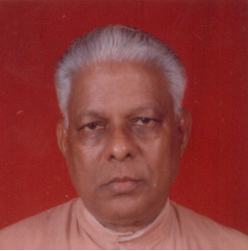
Fr. Gabriel C.M.I
“An eminent scholar in higher education, a revered guru deserving of the love and respect of his disciples, a researcher with a long-standing reputation in the academic world, a cultural leader, a liberator of the marginalized and the destitute, a caretaker of the sick, and above all, a selfless Karma Yogi and spiritual teacher who harmoniously integrates spiritual knowledge and developmental activities” — this is how Fr. Gabriel was honored with the Kerala Sabha Star Award by the Alloor Better Life Movement.
Fr. Gabriel, a polymath, was born on December 14, 1914, to the parents Pavu and Kunjeela of Chirammal Perinngottukara, Manalur, in Thrissur district. His mother passed away when he was just four years old. Under the protection of his father, Gabriel grew up in exemplary Christian faith.
He began his primary education at Manalur Government School and then attended Kandassankadavu High School. While he was in the ninth grade, he recognized his divine calling and joined the C.M.I congregation. He began his studies at St. Joseph’s High School, Paveratti, and completed his high school education in 1933. Subsequently, he joined the Ambozhakkad Monastery. At that time, he was appointed as a novice under the guidance of the revered Bartyalomiya. The training period under Bartyalomiya significantly enriched Gabriel’s life with new enlightenment and spiritual vision. He took his vow of chastity on November 24, 1933. Later, he went to the study house in Koonammavu for language studies, where he mastered Latin, Syriac, and ornamental sciences. After his language studies, he continued his philosophical studies at the Theological Study House in Mutholy and the Sacred Heart Study House in Cherthala. Dr. Placid Podipparay was the chief professor there. It was under Dr. Placid’s unparalleled scholarship that Gabriel deeply understood the essence of Vedic scriptures. After completing a lengthy period of theological study, he was ordained a priest by Mar James Kalassery on May 30, 1942. He celebrated his first Holy Mass on June 2.
His first assignment was as a teacher at Champakkulam U.P. School. After a year, he became a teacher at Mannanam Ashram. He then started intermediate studies at St. Berchmans College, Changanassery. In 1944, he joined the University of Madras and earned a B.Sc. (Honours) in Zoology in 1949. Since many priests had failed the honours exam, the authorities decided not to send anyone else for the honours program. However, because Fr. Gabriel had passed the intermediate exam with a rank, the authorities agreed to send him for the honours course. He was appointed head of the Biology Department at Tevar College in 1949 and later became a professor of Zoology in 1952. Alongside teaching, he engaged in research. Fr. Gabriel was not willing to limit his teaching to classrooms and laboratories. He adopted a teaching method involving fieldwork, traveling to coastal and riverine areas to observe and study animals in their natural habitats. He discovered a new species of fish, which Dr. Balakrishnan Nair, then researching at Madras University, named “Bankia Gabrielii” in his honor.
The year 1953 was a significant period for the C.M.I congregation. The C.M.I congregation was divided into three major provinces. Although Fr. Gabriel naturally belonged to the Devamatha Province in Thrissur, he stayed with the Sacred Heart Province for three years due to their requirements and constraints. He then joined the Thrissur Province.
He undertook efforts to establish a college in Irinjalakuda. Along with KP John of Kandamkulathi and others, he initiated preliminary discussions. Their support became a driving force for Fr. Gabriel. As a result of continuous efforts, the college began operations on June 16, 1956.
Fr. Gabriel took charge as Principal. Under his leadership, the college experienced unprecedented growth, starting undergraduate and postgraduate courses and establishing a women’s section, which later became St. Joseph’s College. A sports enthusiast, Fr. Gabriel’s tenure saw Christ College excel in both arts and sports. The Kannappan Memorial Tournament was started in 1956. Later, Christ College became the only institution in the state to offer Physical Education as an optional subject in the degree course. This foundation, established from the very beginning, led Christ College to repeatedly win first place in university youth festivals. Fr. Gabriel was instrumental in supporting the Holy Family Sisters in establishing St. Joseph’s Women’s College.
Over time, students began to move towards political and social leadership roles. To engage them outside the campus, Fr. Gabriel established the Irinjalakuda Catholic Center. When Fr. Gabriel retired from Christ College on March 31, 1975, he was given a grand farewell.
He served on various official committees, including the Board of Studies, Academic Council, and Senate, at the University of Travancore and Calicut University. His selection to the Calicut University Syndicate after retirement was a recognition of his contributions to education. TR Shankunni, in a 1972 college anniversary report, noted: “In the struggle for private college teachers to obtain direct salaries, my humble service contributed to formulating acceptable conditions for both the government and the management. These conditions were formed during discussions at Mr. KP John’s residence in Irinjalakuda and Christ College. These conditions are sufficient to maintain lasting peace in higher education.”
In 1986, Fr. Gabriel formed the Higher Education Council for Christ College under the leadership of the Thrissur Bishop, addressing the lack of adequate representation for Christian colleges under Calicut University. This council became a strong organization for maintaining high standards in higher education and achieving appropriate representation in university committees. Fr. Gabriel was its long-time president. In 1983, he founded the Indian Institute of Christian Studies to study and research the contributions of the Christian community to the nation’s development. He also tried to establish a Christian Studies Institute at Calicut University in 1986. Fr. Gabriel was the first secretary and later the president of the C.M.I Board, which was established for the reform of the C.M.I congregation.
During this period, he took on various responsibilities within the C.M.I congregation. He found a new location for the Christ Ashram and was elected as the Counselor and Vicar Provincial of the C.M.I congregation in 1966. This was also when he celebrated his silver jubilee in priesthood and initiated the establishment of Snehashadanam in Irinjalakuda. The Arts Kerala was inaugurated in 1974.
In 1975, Fr. Gabriel was appointed as the Provincial of the Devamatha Province. With the support of local people, he worked on establishing an educational institution in Palakkad. On June 1, 1925, the Carmel School was inaugurated by the Kerala Governor. On August 21, 1975, he left for a foreign tour. During the Devamatha Province, the idea of starting a hospital emerged. The Bishop of Thrissur was supportive of this idea. In 1976, the decision was made to establish Amala Hospital. The planning, council approval, and agreement with the Cancer Society in Thrissur were completed. Construction of Amala began in September 1976. The foundation stone was laid in 1978, and the inauguration took place on April 25, 1978, by President Neelam Sanjiva Reddy. The event was attended by Kerala Governor Jyoti Venkatachalam, Chief Minister A.K. Antony, and others. On July 1, 1979, Fr. Gabriel assumed charge as the Director of Amala.
In 1979, Fr. Gabriel served on a commission related to the division of the C.M.I St. Joseph Province. Under his leadership, Amala Hospital continued to develop. In January 1990, the Nursing School was established. In October 1981, an Ayurveda unit was inaugurated, followed by the Radiation Therapy Block in 1982. The Research Department was established in 1982 and recognized by the Indian Council of Medical Research. On June 18, 1982, the Ayurvedic Research Center was inaugurated, and on December 12 of the same year, the Amala Fellowship was established. The Research Block was inaugurated on November 20, 1963, and the Golden Jubilee of the Priesthood was celebrated on November 24, 1989. In 1984, a special research society was registered and began operations. In 1985, it received recognition from Calicut University. On November 23, 1985, the Teratron 780 was inaugurated. On January 4, 1987, the Amala Mobile Unit was inaugurated, and on December 14 of the same year, the new cancer ward’s foundation stone was laid. In 1988, Ayurvedic treatment centers were started, and in 1990, a Homeopathy unit began operations. In 1990, Fr. Gabriel was a member of the commission on the division of the Sacred Heart Province. On May 30, 1992, he celebrated the golden jubilee of his priesthood. When the C.M.I congregation was divided into three, Fr. Gabriel, a young priest of the Devamatha Province, devoted himself fully to its growth. He played a vital role in the establishment and development of the Coimbatore region and institutions like Little Flower Mission Center, Pollachi Vishwadeepthi School, and Palakkad Bharata Matha School.
Fr. Gabriel was elected to all provincial councils and general assemblies since 1953


Leave a Reply