
Notable Figures of the Kerala Church – 12
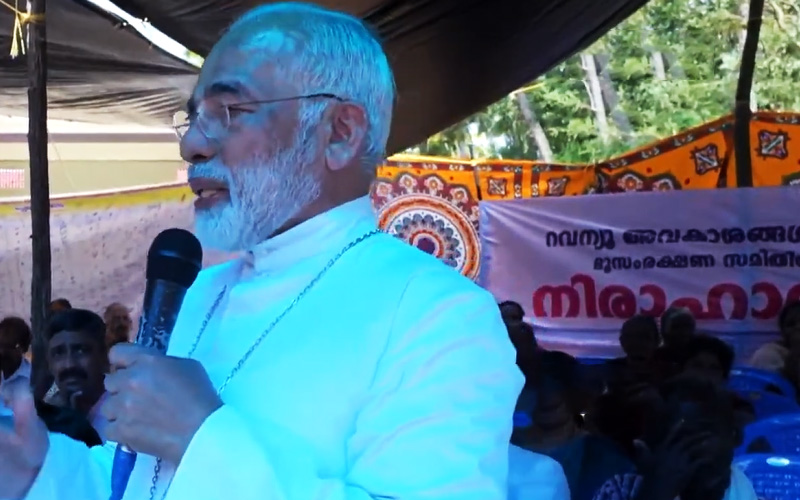
Archbishop Dr. Cornelius Elanjickal
“The fragrance of poetic inspiration bestowed upon Kairali was given by just one guardian – Archbishop Dr. Cornelius Elanjickal. While leading a community with fervent faith, he also prepared hymns of divine words during intervals. The divine hymns, which touch the heart upon mere listening, continue to be created by him even in his contemplative life.” The words quoted above are from the Kerala Latin Catholic Directory about Archbishop Cornelius Elanjickal.
Archbishop Cornelius has written his autobiography titled “Unforgettable Memories.” His autobiography is unique among others for including numerous poems. One section of the autobiography discusses contemplatives, accompanied by a poem, which is provided below.
“Let us not forget one fact. Contemplatives are like those who provide connections while speaking at a telephone exchange. They are actually communicating with God. It is from there that they speak to the contemplatives and transform them. When they unite with that place, their divine life is imparted to us. We, having been refreshed, produce good results. Like a branch of the grapevine, I am a good grapevine and its branch – Lord, I am a branch of that vine. Whenever I stand united with You, You impart Your life to me. I will grow quickly, I will bloom, and I will produce sweet fruits. If I am even slightly separated from You, the vine will wither, the flowers will not bloom, and there will be no fruit; I will turn into a worthless bunch of leaves, becoming a useless bunch of vines. This is a highly meaningful poem. It is with many such thought-provoking poems that he has written his autobiography.”
Cornelius Elanjickal, who was very adept at handling both prose and poetry, was born on September 8, 1918, at the Elanjickal family in Kaara near Kodungalloor. His baptism was conducted on the feast day of Saint Cornelius. As per the priest’s suggestion, the child was named Cornelius. At home, he was called Ittyavira. His childhood was fraught with difficulties, including a severe typhoid illness that caused him to lose consciousness. He fell into water two or three times and was thought to be lost. Surviving all these, Ittyavira continued his education. He studied at the Kaara Primary School, Edavilla Government School, and various government schools. Students who passed the seventh grade were admitted to the seminary. Ittyavira, raised under the care of deeply faithful and devout parents, had aspired to become a priest from a young age.
In May 1933, he entered the Minor Seminary. Alongside, he joined St. Albert’s School and completed his high school education. Latin studies began in the Minor Seminary. Later, he joined the Pontifical Seminary in Mangalappuzha in 1938, where he studied philosophy for a year. Subsequently, he was sent to Rome to continue his studies at the Propaganda College. On October 10, 1939, he sailed to Rome. Once in Rome, he continued his studies and had several opportunities to visit Pope Pius XII. With Italy’s involvement in World War II, the threat of enemy aircraft and air raid warnings became frightening. Seminary students spent countless hours in the underground shelters. After six years of study, on March 18, 1945, he received the priestly ordination from Cardinal Fumasoni Biondi. He also obtained his Doctorate in Canon Law and Philosophy from Rome. His doctoral thesis was on “The Divine Purpose in the Brihadaranyaka and Chandogya Upanishads.”
Monsignor Brissi, who was the Rector of the Seminary, was appointed as the bishop of the joint diocese of Osimo-Singoli. Among those chosen to accompany him to the Osimo diocese was Cornelius. A large crowd gathered in Osimo to welcome the new bishop. During a public meeting that followed, Cornelius gave his first speech in Italian.
When Archbishop Attipetti arrived in 1947, Cornelius worked hard to ensure he received a warm welcome and the necessary support. As he was about to return home after completing his studies at Propaganda, officials asked if he could teach Hindu philosophy at a university. Upon his return, he decided to work as per his father’s advice. During the return journey, he spent ten days in Lourdes, then traveled to England and arrived in Bombay by sea. From there, he proceeded to Madras and then to Ernakulam.
His first appointment was as an assistant priest in the Chathya parish. After nine months, he was appointed as the secretary to his father. After three years, he served as an assistant in the Cathedral church. At that time, the Novena was in English, and he published a translation of the English book into Malayalam. He was later appointed as the Rector of the Minor Seminary, where he provided students with opportunities for yoga practice, advising them to practice for 20 minutes daily. He was later moved from the rector position to become the assistant to the Vicar General, and then served as Pro-Vicar General, Vicar General, and Vicar Capitular.
Following the Vatican’s Second Vatican Council, he was part of the committee appointed to translate liturgical services into the mother tongue, which was successfully completed.
When Archbishop Attipetti passed away, Cornelius was appointed as the Administrator. On April 4, 1971, he was appointed as the bishop of the Vijayapura diocese. Cardinal Lourdes Swamy was the main celebrant of the episcopal consecration ceremony. On April 28, 1971, he assumed authority in Vijayapura, a large diocese with an area of 8,999 square kilometers. The diocese encompassed various rites and church segments, and he maintained friendships with not only Catholic bishops and priests but also other church groups. The joint Christian celebrations held by all church segments were particularly memorable.
Adhering to the principle that the salvation of Vijayapura should come from its own people, he promoted vocations to the priesthood and religious life from Vijayapura. He paid special attention to religious education, shaping it into a central focus. On September 26, 1976, he celebrated a day for the renewal of religious education, advocating unity and cooperation while rejecting all forms of division and promoting divine mercy and devotion to Mary. He organized music competitions to enhance the vibrancy and devotion of temple music. He encouraged uninterrupted family prayers and revitalized the work of the Vincent de Paul Society within the diocese.
He also planned projects to further assist Dalit Christians, preparing a package development program with over a hundred projects, which was submitted to Father Fosek, the President of the Indian Social Institute. This program received approval. Cornelius took steps to guide Dalits into priesthood and religious life. During the golden jubilee of the diocese in 1980, 50 development projects were presented successfully. He conducted medical examinations for around 3,000 children. In 1974, he visited Mother Teresa in Kolkata and this visit helped invite the Missionaries of Charity, known as Mother Teresa’s sisters, to Vijayapura. On April 2, 1979, he played a key role in organizing a major protest and public meeting against religious discrimination, held by the Kerala Christian Leaders Action Council in Thiruvananthapuram. His service, which provided affection and recognition, extended to the cultural sectors in Kottayam. After an unparalleled 15-year pastoral service, he was appointed as the Archbishop of the Archdiocese of Varapuzha on March 18, 1987.
His work was aimed at the spiritual and material upliftment of the Latin Catholic community. The Ashir Bhavan, the central pastoral center of the archdiocese, is a testament to his dedicated work. He served for six years as the Chairman of the Bible Commission of the All India Bishops’ Conference. Archbishop Cornelius made significant efforts to activate family units within the diocese. When he assumed the role of bishop of Vijayapura, the literary expert T.M. Chummar wrote in the supplement published by Deepika:
“Thomas the Apostle, who brought the message of Christ to Kerala, was indeed the one who sowed the seeds of Christianity in this land. Those who received his message and advanced in the path of Christ are the ancestors of the present-day Christians in Kerala. The Portuguese missionaries’ entry into Kerala and the subsequent conversions included a section of the ancient Christians into the Latin rite, resulting in the Latin Catholics we know today. A significant section of Latin Catholics in central Kerala, particularly in the dioceses of Varapuzha and Kochi, are the ancient Mar Thoma Christians converted into the Latin rite. The Elanjickal family, located near Kodungalloor in Kaara, is part of this Thomma Christian tradition. Our revered archbishop was born into this family. The family has traditionally honored and celebrated Aryavaidya, the esteemed physician from their area.”



Leave a Reply