
Prominent Figures of the Kerala Church-69
Mar Joseph Pallickaparambil
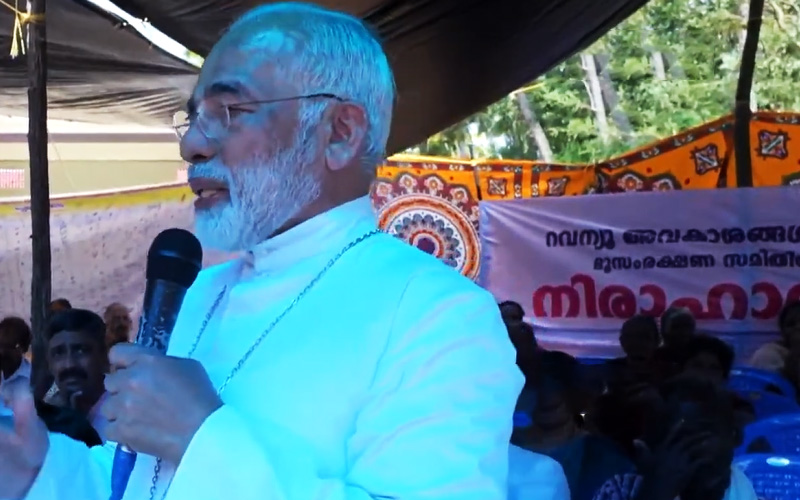
Revered Father, esteemed teacher, sincere friend, dedicated shepherd, capable church leader, courageous lover of the church who was unwilling to compromise on principles for the sake of success, and a steadfast authority unafraid to take a hard stance for Christian beliefs, justice, and morality—these are various roles through which Mar Joseph Pallickaparambil is known. He was born on April 10, 1927, as the second son of Devasya and Kathrina in Pallickaparambil, Mutholapuram.
After completing his schooling at various institutions including Mutholapuram Government Primary School, Elanjin St. Peter’s English Middle School, Vazhakulam Infant School, and Mannanam High School, he joined Changanassery S.B. College for his intermediate studies. He resided at St. Joseph’s Hostel, where he showed no reluctance in adhering to hostel rules. After passing his intermediate in 1945, P.D. Joseph pursued a B.A. in Philosophy at St. Joseph’s College, Thirsshinappally, where he excelled and secured a medal for first place in the examination. He continued his education at Loyola College in Madras for his M.A. under the principal, Father Jerome D’Souza, who was a member of the Indian Constitution Drafting Committee, gaining his favor.
In 1949, after passing his M.A., Joseph received an invitation to teach at Changanassery S.B. College, which he graciously declined. During his student days, as a farmer’s son, he actively assisted his father in agricultural tasks, showing great enthusiasm in feeding and watering cattle and taking plows to the fields. He declined to pursue the IAS exam despite many urging him. In 1949, upon completing his college education, he joined the Changanassery Archdiocese’s Parelle Minor Seminary and later continued his studies at Mangala Pooram Seminary. After starting his studies in philosophy there, he was sent to Rome for further studies.
Following the establishment of the Palai Diocese, he became the first priest student sent to the Propaganda College in Rome in 1952. After completing his studies in philosophy and theology, he was ordained a priest in Rome. On November 23, 1958, he received his priestly ordination from Cardinal Gregory Peter Aggianian in the chapel of Urban College in Rome. Since he was ordained in Rome, no relatives or friends were present for the ceremony.
After his ordination, he remained in Rome to pursue further studies in theology. During this period, Cardinal Eugene Tisserant, the secretary of the Propaganda Congregation, took the initiative to establish a seminary for the Syro-Malabar Church in Rome. While other Eastern Catholic churches had colleges in Rome, the Syro-Malabar Church, which ranks second in terms of membership among Eastern Catholic churches, did not have its own college there. The Propaganda College, which admitted students from mission countries, did not allow Syro-Malabar Church members proper access. Due to the political situation at that time, the number of students at the St. Josaphat College established for the Ukrainian Church had decreased, and Tisserant decided to allocate part of that college for the Syro-Malabar Church.
Father Placid Podipara, a scholar and pride of the Syro-Malabar Church, was a member of the planning committee for the Oriental Congregation. He was appointed as the rector of the Malabar College established for the Syro-Malabar Church. Our main character, Father Joseph Pallickaparambil, was appointed as vice-rector. Thus, Joseph, who was studying for a doctorate, became one of the leaders of the seminary.
In 1962, Pallickaparambil Achchan returned home after earning a doctorate in theology with great distinction. After 11 years of being ordained a priest in Rome, he returned to his parish of Mutholapuram in the fourth year and celebrated the Divine Liturgy. When the Vadavathur Seminary was established on July 3, 1962, Pallickaparambil Achchan was appointed as a professor of theology. In 1965, he was appointed as the Vice Rector of his alma mater, the Propaganda Urban College in Rome, and he began working there in October 1965.
Rev. Dr. Kurien Mattam wrote in the Pala Diocese Golden Jubilee book: “When the Vadavathur Seminary needed a new rector after four years, the bishop’s committee could find no one other than Father Pallickaparambil. He returned home in May 1969, at a time when several bold decisions needed to be made for the seminary. Although there were many crises, the new rector successfully navigated them all.”
While serving as the rector of Vadavathur Seminary, Father Pallickaparambil was chosen to assist the Bishop in the Pala Diocese. He was consecrated as Bishop on August 15, 1973, in a grand pavilion built at St. Thomas College, Pala. The consecration ceremony was conducted by Cardinal Mar Parekkattil, with Bishops Mar Sebastian Vayalil and Mar Sebastian Vellappally as co-consecrators.
Upon his appointment as bishop, discussions began regarding his approach and policies. With the desire to establish a family support fund that would work regularly at the diocesan level, it was decided on the day of his consecration to create a family assistance fund. Within a year, they managed to collect two lakh rupees. This fund was expanded each year, with collections conducted in connection with Christmas, aimed at effectively supporting welfare activities. The establishment of this fund can be seen as the realization of Pallickaparambil Thirumeni’s dream, providing some relief to families experiencing financial distress. Today, this fund is used for marriage assistance and housing construction.
In every sense, Pallickaparambil Thirumeni was the successor of Vayalil Father. As the Bishop of the Pala Diocese, he was the Chairman of the K.C.B.C. Divine Call Commission from 1975 onwards. He also served as the Chairman of the CBCI Bible Commission for two years.
He actively participated in the forefront of the total abstinence movement, traveling that path with dedication. From 1976, he served as the President of the All Kerala United Christian Anti-Drugs Committee. His contributions as the Chairman of the All Kerala People’s Anti-Drugs Front should never be forgotten. He was always ready to lead marches and undertake fasting in support of the anti-drug movement. After Bishop Pallickaparambil announced a fast against the liquor policy of the Nayinar government, the government was pressured to withdraw the policy within 24 hours, and representatives rushed to the Pala Aramana, an event that remains memorable for many.In every sense, Pallickaparambil Thirumeni was the successor of the Vayalil Father. He served as the Chairman of the Divine Call Commission of the KCBC and held the position from 1975. He was also the Chairman of the CBCI Bible Commission for two years.
As an advocate of the temperance movement, he actively traveled that path. He served as the President of the Kerala Joint Christian Temperance Committee from 1976. His services as the Chairman of the Kerala People’s Anti-Drunkard Front are unforgettable. He was ready to lead marches and observe fasts for the cause of temperance. After Bishop Pallickaparambil announced a fast against the liquor policy of the Nayinar government, the government acted swiftly to withdraw the policy within 24 hours, an event that remains memorable for us.
We failed to pay sufficient attention to the spiritual needs of the thousands of Syro-Malabar Church members living outside Kerala and India. In the Jubilee memorial of the silver anniversary of the church, Rev. Dr. Kurien Mathew wrote: “It is the responsibility of the mother church to carefully cater to the spiritual needs of Syro-Malabar faithful who have gone abroad in search of work.” This awareness was strengthened with the council’s involvement. Many thousands of our faithful reside in major cities in India such as Mumbai, Kolkata, Delhi, Chennai, and Bangalore. While some visited nearby churches for spiritual needs, there was no one responsible to inquire about them or ensure the faith formation of their children. The Latin church authorities could not adequately consider these growing numbers each year. Not only were they disconnected from the mother church, but many were also at risk of drifting away from faith.
To address the issues of those living outside Kerala, the Syro-Malabar Bishops’ Conference (SMBC) formed a commission and elected Mar Pallickaparambil as its chairman. The priests sent to Mumbai and other places studied the various problems faced by our faithful and devised timely plans. Such efforts laid the groundwork for establishing the Kalyan Diocese over time. However, due to the lack of cooperation from some responsible church members and a narrow mindset, the Malabar Church could not establish its dioceses in other major centers in India. As part of this responsibility, the father also traveled to America. He took the initiative to establish parish churches and appoint clergy in Texas and other locations. Recently, it was brought to the Vatican’s attention that a significant number of Syro-Malabar Church members live in European countries such as Germany, Italy, Austria, and Switzerland. Yet, no one had clear knowledge of how many there were or how their spiritual needs were being met. In this context, the Pope appointed an apostolic visitor to European countries. In 1996, the venerable father visited several major cities in Europe, including Rome, Frankfurt, Bonn, and Vienna, discussing with the faithful and understanding their circumstances. After completing the assigned mission, he submitted a detailed study report in Rome, which played a crucial role in the growth of the Syro-Malabar Church.
Pallickaparambil Thirumeni’s educational vision mirrored that of Bishop Pallickaparambil. He had clear perspectives and ideas regarding higher education. During his tenure, the growth of educational institutions made significant progress. When he took charge of the diocese, there were 5 colleges, 42 secondary schools, 34 upper primary schools, 74 lower primary schools, and 111 nursery schools in the Pala diocese. Today, there are 9 colleges, 24 higher secondary schools, 60 secondary schools, 90 upper primary schools, 130 primary schools, and 178 nursery schools in the diocese. This growth in education is among the notable achievements of Pallickaparambil Thirumeni. He insisted on having exemplary discipline in our colleges. Thirumeni consistently advocated for value-based education. He often reminded teachers of the need for religious studies and value-based education in schools and colleges. He placed particular emphasis on technical education in the Pala diocese. Recognizing job opportunities in the new century, he initiated the computer learning center in Pala, which has now become a renowned institution. This center has helped thousands of students acquire jobs by offering various high-quality computer courses at low costs.
The Vayalil Library was established in memory of Bishop Vayalil Thirumeni. This center trains students for competitive exams conducted by various recruiting agencies in India, such as UPSC, PSC, and BSR. Many underprivileged students have found jobs through this initiative. The Human Resources Development Center and Civil Service Training College, established in Pala under the joint supervision of the Changanassery, Pala, and Kanjirappally dioceses, have become well-known institutions. These institutions stand as a testament to the long vision and social commitment of Pallickaparambil Thirumeni.
Dr. Babu Sebastian wrote in the Bishop’s Jubilee commemorative publication: “The Sevanikethan Society, started by the father, aims to provide employment training for young people willing to work. Various employment training centers initiated by the revered father across the diocese provide training in furniture making, garment manufacturing, candle making, handicrafts, and Christmas card production for thousands of youth.”
Many projects for the upliftment of women and children have been initiated in the Pala diocese under the leadership of the revered father. Some of these include Sajeevani, a self-employment training program for women from poor families; Jeevavardhini, which trains women to become good homemakers; Grihalakshmi, which trains girls in home nursing; Shishusadan, aimed at the holistic development of children; Save a Family Plan, which supports underprivileged families; and the Regular Beneficiary Program, along with self-help groups spread across various parishes. The Janasabhaagya project aims to raise awareness about family health.
All these activities were guided by Pallickaparambil Thirumeni. He initiated numerous projects to provide comfort to marginalized and suffering groups in society. Many charitable initiatives emerged from his compassion and kindness toward the marginalized.
More than 12% of the believers in the Pala diocese are Dalit Christians. Several leaders have worked for their upliftment within our diocese, including Nidhirikkal Manikathanar, Melvattom Yakobachan, Pallickaparambil Paulosachan, Daivadasan Kadalikatt Mattayichan, and the revered Thevarparambil Kunjuachan. Bishop Mar Sebastian Vayalil planned numerous initiatives to protect the interests of Dalit brethren. He promoted the organization D.C.M.S. The father followed a similar model. The Pala diocese offers special consideration and recognition to Dalit Christian brothers. Bishop Pallickaparambil has reserved a deserving share for Dalit Christians in the colleges and nursing schools under the diocese. They receive due consideration for job vacancies in educational institutions. Additionally, the father has planned various schemes to assist Dalit Christians through housing support, educational assistance, marriage aid, and more. He has also expressed readiness to organize grand assemblies and lead rallies for the protection of Dalit interests. On April 2, 1979, he was at the forefront of a demonstration in Thiruvananthapuram against discrimination in the name of religion.
In memory of Pallickaparambil Thirumeni’s episcopal silver jubilee, four charitable projects were initiated. One involved constructing 1,000 homes for the poor. The Marerara program aimed at establishing a home for the elderly. The renovation of the old age home in Kadanattu was undertaken for this purpose. Another project included a cancer hospice and a care center for AIDS patients.
Pallickaparambil Thirumeni firmly declared that the foundation of society is the family, emphasizing through teachings that nothing should harm the sanctity of the family or its divine plan. He called upon parish priests to take appropriate actions in this regard. During his parish visits, he often spoke specifically about the sanctity of families, the importance of prayer, and moral consciousness. He put considerable effort into strengthening family gatherings.
Pallickaparambil Thirumeni took a keen interest in organizations such as the St. Vincent de Paul Society, Pala Social Welfare Society, and Sevanikethan, which lead charitable activities. His leadership in faith formation initiatives, family apostolate, vocation bureau, communication media, and evangelization activities is commendable. He has strongly encouraged the activities of various organizations, including the Catholic Students Movement, Legion of Mary, Mathrujyothi, Catholic Teachers Guild, Sodality, Franciscan Third Order, Thirubalasakham, and the Papal Apostolic Society.
Pallickaparambil Thirumeni played a pivotal role in the growth of the Small Flower Mission League established in the Pala diocese. His contribution to the grand success of the mission league’s golden jubilee celebration was significant. He paid special attention to strengthening the youth movement known as K.C.Y.M. The Syro-Malabar Church Synod appointed Pallickaparambil Thirumeni as the Bishop’s Advisor for the Catholic Congress, reflecting his longstanding interest in it. His issuance of specific circulars to strengthen the activities in the Pala diocese and the financial assistance provided for acquiring special equipment for the diocesan assembly are noteworthy.
Rev. Dr. Placid Podipara was a mentor to Mar Pallickaparambil during his time in Rome. The father resonated deeply with Fr. Placid’s ideas. It can be said that it was Placid who guided the revered father toward a firm understanding of the identity and heritage of the mother church. Pallickaparambil Thirumeni holds a profound pride in the Syro-Malabar heritage. The golden jubilee celebration of the Pala diocese was held grandly in 2001 with a four-day program, including various events.

admin_nrp30b5e
Website: https://sathyadarsanam.webovasoft.in



Leave a Reply